
How to Layer Dark Tones in a Small Living Room
Dark Tones Are Not the Enemy of a Small Room
The instinct when a sitting room is compact is to paint everything pale and hope it recedes. In practice, pale walls often do the opposite: they show every awkward corner, every pipe boxing and every less-than-perfect ceiling line, and the room reads as a bright but cramped box. Dark walls blur those boundaries. A deep, saturated surface absorbs light and softens the joins between wall, ceiling and floor, so the space reads as one continuous whole rather than a series of edges.
What makes dark schemes fail in small rooms is never the colour itself. It is the absence of three things: contrast, texture and warm light. Get those right and a compact sitting room becomes enveloping and quietly luxurious rather than closed in.
Choose a Dark With Warmth Beneath It
Not all darks behave the same way. A cool blue-black can turn icy and unwelcoming in a north-facing room, while a flat, pure black can look lifeless once the lamps are on. Look instead for darks that carry warmth in their undertone: charcoal with a green or brown base, deep olive, aubergine, espresso, or a soft inky navy that leans grey rather than cobalt.
Test before you commit. Paint a panel at least A3 size, fix it to the wall, and look at it in the morning, mid-afternoon and after dark with the lamps switched on. Colours shift dramatically across the day, and a shade that looks wonderful at noon can go flat by nine o'clock.
Finish matters as much as colour. A low-sheen matt emulsion on the walls keeps the surface soft and light-absorbing, while eggshell on woodwork a shade or two either side gives crisp definition without glare. Save your sheen for skirting, doors and joinery — glossy walls in a small room bounce light back at you and can quickly look busy.
Break the Dark With Lighter Textiles
This is the single most important move in the whole scheme. Dark walls want something to lean against, and that something is cloth. Textiles introduce softness, sound absorption and the contrast that stops a deep room feeling like a cave.
- The sofa: an oatmeal, warm stone or soft chalk upholstery in linen, cotton or bouclé will lift a dark wall instantly. Keep the shape clean and low-armed so it does not dominate the floor plan.
- The rug: go larger than feels necessary. A pale wool or woven jute rug that runs almost wall to wall makes the floor plane continuous and pushes the dark walls outward.
- Cushions: layer three or four, mixing a pale neutral with one or two mid-tones — rust, camel, muted sage — so the eye has somewhere to travel between light and dark.
- Curtains: hang them from close to the ceiling and let them fall to the floor. Full-height, generously gathered fabric adds verticality, which a small room badly needs.
Think in ratios: roughly sixty per cent dark, thirty per cent mid-tone, ten per cent pale. It sounds pedantic, but it is the balance that keeps a dark room feeling curated rather than gloomy.
Light It in Layers, Warmly
A single overhead light in a dark room is a disaster — it flattens the walls, casts shadows upward and makes the space feel smaller. Layer instead, with at least three sources at different heights, all on warm white bulbs and all dimmable.
- Low: a table lamp beside the sofa, ideally with a fabric or alabaster shade that glows rather than glares.
- Middle: a slim wall light or picture light washing across the dark paint. This is where dark walls earn their keep — warm light grazing a deep surface is the whole point.
- High: a dimmable pendant or a pair of ceiling spots on a low setting, aimed away from seating so nobody is squinting.
Warmth is non-negotiable. Cool white bulbs will kill the scheme stone dead; aim for a soft, amber-leaning glow. If the room still feels cold after a week, change the bulbs before you change the paint — it is the cheapest fix you will ever make.
Add Depth With Reflection and Contrast
A mirror is the traditional small-room trick, and it still works. Place one opposite a window, not facing it, so it reflects daylight rather than blocking it, and keep the frame dark or metallic so it feels intentional rather than decorative.
Metallics are the quiet luxury here. Aged brass, bronze or antique gold in small doses — a lamp base, a curtain pole, a tray — catch warm light and give the eye a glint of contrast against the matt walls. Art hung on a pale mount or in a light-toned frame also helps; the mount acts as a small window of brightness within the dark field.
Keep the Palette Tight and Edit Ruthlessly
Small rooms forgive almost anything except clutter. Limit yourself to three or four related tones and repeat them — the same neutral on the sofa and curtains, the same metal on two or three objects, the same dark on walls and any built-in joinery.
If the ceiling is generous, take the dark colour straight over it for an unbroken, cocooning effect. If it is low, keep it a soft warm white so the eye is drawn upward. And be disciplined about what sits on surfaces: one statement piece, one lamp, one stack of books. The dark will do the rest.
tag: Interiors

James Alderney Author
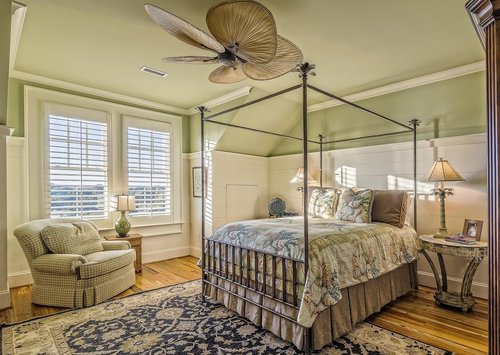
Balance dramatic charcoal walls with oatmeal bedding and subtle textures for a restful scheme that still feels sophisticated and modern.
YOU MAY ALSO LIKE
Creating a Calm Bedroom with Charcoal and Soft Neutrals
Sep 23
10Pair rich forest green with antique wood and brass details to bring depth to period properties without overwhelming original features.
read more
Using Deep Green Accents in Traditional British Homes
Sep 21
10Understand undertones and finishes before committing to black, from soft charcoal to inky hues that suit different light levels.
read moreInteriors
-

ERRIC CATONA
Paint large sample patches and observe them throughout the day to see how natural and artificial light changes the colour.
May 19, 2016 at 5.12 pm
Reply
ERRIC CATONA
Fill cracks, sand surfaces and use the correct primer so deep colours dry evenly without patches or visible roller marks.
May 19, 2016 at 5.12 pm
Reply -
ERRIC CATONA
Combine inherited pieces with clean-lined contemporary seating to create a collected look that feels warm and intentional.
May 19, 2016 at 5.12 pm
Reply
Paint
Your email address will not be published.